
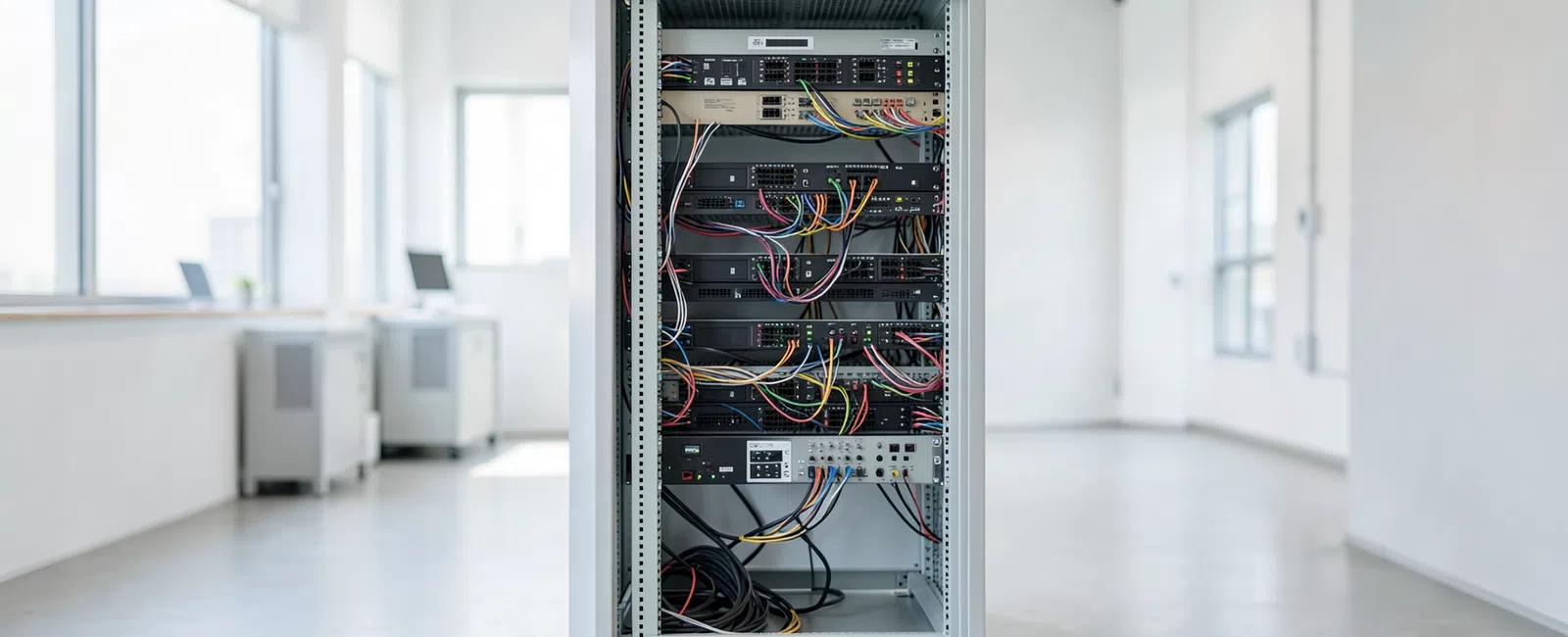
Yes. GDS Technology can coordinate cabling, riser access, ISP handoffs, and low-voltage work with your landlord or property manager, giving you 1 accountable lead across building management, carrier scheduling, and installer logistics. That reduces missed access windows, demarc confusion, and last-minute delays that can stall move-ins, expansions, or suite reconfigurations.
Key figure: 1 accountable coordination lead across landlord, carrier, cabling, and low-voltage work.
Why does landlord and property-manager coordination matter on cabling and internet projects?
Most office technology projects do not fail because the cable is hard to pull. They fail because the building controls access, timelines, pathways, and approvals. If the landlord, property manager, ISP, and low-voltage team are not working from the same sequence, the technical work starts late or gets done twice.
In multi-tenant buildings, riser access is usually controlled. Telecom closets may require escorting, after-hours scheduling, vendor COIs, loading instructions, or advance notice for contractor entry. When those steps are missed, crews show up but cannot touch the building infrastructure that connects your suite to the carrier.
That delay creates a business problem, not just a project problem. Phones stay offline. Cameras remain uncommissioned. Conference rooms are not ready. Staff move into a space that looks finished but cannot support normal operations. For medical, legal, financial, and commercial real estate environments, that gap is visible immediately.
Norcross office users often operate in practical, deadline-driven environments where the building relationship matters as much as the hardware list. Along the I-85 corridor, many businesses occupy shared office properties with strict access rules and shared telecom infrastructure. Good coordination respects how those buildings actually run.
Relevant planning often overlaps with commercial real estate technology support because riser access, tenant improvements, suite turnover, and building-side communications are part of the real project scope, not side issues.
Building coordination drives project outcomes.
What does GDS actually coordinate with the landlord, property manager, ISP, and low-voltage vendors?
The first step is establishing who owns what. On many projects, the landlord or property manager controls building access and riser approvals, the carrier controls circuit delivery and demarc expectations, and the cabling or low-voltage team controls suite pathways, drops, terminations, and device placement. Someone has to connect those decisions before install day.
That coordination usually includes identifying building contacts, confirming the approved access process, documenting contractor requirements, and clarifying where the carrier handoff will land. It also includes reviewing whether existing cabling can be reused, whether a new path is required, and whether telecom-room access affects timing.
From there, the work becomes operational. The sequence has to be right. If the ISP installs before the pathway is cleared, the handoff can land in the wrong place. If cabling starts before the demarc location is confirmed, crews may terminate to a layout that later has to change. If camera or access-control work shares the same pathways, every delay compounds.
GDS can coordinate the moving parts that matter to occupancy and daily use: carrier handoff planning, riser access, suite cabling, wireless access point placement, conference-room readiness, camera coordination, access-control dependencies, and low-voltage scope that supports how the business actually operates. That matters when a business needs the site to function on day 1, not eventually.
When a project includes security devices or front-of-house coverage, that coordination can also align with business video surveillance systems so camera placement, cabling routes, and building access happen within the same project rhythm instead of becoming a separate scramble.
Clear scope prevents preventable rework.
How does the coordination process work from planning through turn-up?
A disciplined project starts with site reality, not assumptions. The team needs the suite layout, occupancy plan, internet requirements, phone or conferencing needs, existing carrier status, building access rules, and any deadlines tied to a lease, reopening, expansion, or tenant improvement schedule. Without that baseline, scheduling is guesswork.
Next comes dependency mapping. The riser path may need approval before the ISP can finish its work. The demarc location may need to be verified before structured cabling can be finalized. Wireless, cameras, and access-control devices may share pathways, closet space, power dependencies, or installation windows. A project manager has to make those dependencies visible early.
Once that is clear, the process usually follows a practical sequence:
- Confirm business requirements for connectivity, coverage, security devices, and room readiness.
- Identify landlord, property-management, and carrier contacts.
- Review riser rules, telecom-room access, contractor requirements, and scheduling restrictions.
- Survey existing pathways, demarc expectations, closet locations, and reusable cabling.
- Define low-voltage scope, cutover steps, and cross-vendor dependencies.
- Schedule carrier and installer work in the correct order.
- Validate live service, coverage, room usability, and device readiness before handoff.
That last step is where weak vendors often stop too early. A live circuit is not the same as an operational site. The real test is whether staff can work, guests can connect as intended, conference rooms behave correctly, and security devices are online in the right places. Technical completion without operational validation leaves the client holding the risk.
For Norcross businesses, this is especially important during suite changes and office turnover. Property teams may be responsive, but they still operate on building procedures. A partner who can translate technical dependencies into landlord-ready action items helps the project move faster because the request arrives organized, complete, and timed correctly.
Sequence control protects the opening date.
What problems show up when riser access, cabling, and ISP handoffs are not tightly managed?
The most common problem is timeline drift. A carrier appointment gets booked before access is approved. A low-voltage crew is scheduled before the pathway is cleared. A closet key is missing. A building engineer is unavailable. None of those failures sound dramatic on paper, but together they can push a project past a move-in or launch target.
The second problem is partial readiness. The internet may technically be on, but the private offices are not patched correctly. The conference room display works, but the room has no stable network connection. Cameras are mounted, but recording or remote access is incomplete. The office looks ready because the visible hardware is installed, yet the environment is still fragile.
Another failure point is handoff confusion. If the carrier expects one demarc location and the cabling vendor builds to another, the final connection becomes a field argument. That wastes billable time and often triggers another visit. The client pays in delays, management overhead, and employee frustration.
There is also a security and governance issue. In mixed-use offices, guest traffic, staff devices, business systems, cameras, and access-control devices should not be treated as one undifferentiated network problem. Poor coordination during install can create messy segmentation, unclear ownership, and hidden dependencies that surface later as outages or audit concerns.
For sectors like healthcare, legal, and financial services, those mistakes carry more than inconvenience. They can affect client confidence, intake operations, communications reliability, and the professionalism of the workplace. A suite that opens with unstable connectivity or unfinished security infrastructure creates avoidable reputational damage.
Unmanaged dependencies become business disruptions.
How does this help Norcross businesses and commercial tenants specifically?
Norcross is not just a map pin. It is a practical operating environment with office parks, multi-tenant commercial properties, mixed-use suites, and businesses that need dependable service without wasting weeks on vendor chasing. In that setting, the value of coordination is speed, accountability, and fewer surprises between lease paperwork and live operations.
Businesses in Norcross often need more than a one-time installer. They need a technology partner that can handle the overlap between wiring, landlord communications, internet turn-up, and post-install support. That is especially true when a space supports client meetings, compliance-sensitive workflows, shared teams, or multiple device classes across one location.
GDS Technology is based in Norcross, Georgia and serves clients as a Technology Partner rather than a break-fix vendor. That matters because landlord coordination is not just a cabling question. It affects how the office opens, how issues are escalated, and whether the technology environment is being managed with long-term ownership in mind.
When the physical project turns into an operational one, businesses can also connect the buildout to managed IT services for ongoing support after turn-up. That creates continuity between installation, cutover, endpoint readiness, and day-to-day service instead of leaving the business with a disconnected stack of vendors.
For companies evaluating providers close to the site, local context also matters. The needs of a Norcross office can differ from a greenfield build in another market because the bottleneck is often building process, not product selection. A local partner who understands how commercial spaces behave can move the job forward with less friction.
If you want service tied to the local market, the most relevant context is GDS support in Norcross, GA, where building access, vendor sequencing, and business continuity often matter more than marketing language.
Local coordination reduces friction and follow-up.
What should you ask before handing this project to an IT or low-voltage partner?
Start with accountability. Ask who owns communication with the landlord, property manager, ISP, and installation vendors. If nobody can answer that in one sentence, the coordination burden will land on your office manager, operations lead, or internal admin team. That is where avoidable delays usually begin.
Ask how the provider handles prerequisites. Do they confirm riser procedures, telecom-room access, contractor paperwork, and demarc expectations before booking site work? Do they document dependencies between cabling, carrier turn-up, cameras, and access control? A partner that skips those steps is relying on luck.
Ask what success looks like at turnover. “The circuit is live” is not enough. “The drops tested clean” is not enough. You need confirmation that users can work, conference rooms are functional, wireless coverage is usable, and any security devices tied to the space are actually online and behaving as expected.
Ask whether the provider understands tenant-facing business risk. Downtime during a move, opening, or suite reconfiguration is not an abstract technical issue. It affects client meetings, employee productivity, member experience, and leadership confidence. The right partner will speak in those terms, not only in terms of cable categories and hardware counts.
If you need a public metric that is not published yet, the honest answer is to ask for it directly rather than filling the page with invented numbers: [OWNER: describe whether you want typical landlord-coordination milestones, standard site-readiness checkpoints, or a published project-intake timeline for Norcross-area buildouts].
Choose coordination discipline, not just installation capacity.
Frequently asked questions
Do you work directly with landlords and property managers during a coworking buildout?
Yes. GDS Technology can work directly with landlords and property managers during a coworking buildout to align access, riser approvals, contractor scheduling, and suite pathways with ISP and low-voltage work. That gives the operator 1 coordination path, reduces avoidable delays, and protects opening-day readiness across member-facing spaces.
Can you coordinate ISP handoffs and structured cabling at the same time?
Yes. ISP handoffs and structured cabling should be coordinated together because both depend on the same demarc, pathway, closet, and scheduling decisions. Managing them as 1 project reduces rework, prevents field confusion, and helps ensure Wi-Fi, phones, private offices, and conference rooms are ready when the location goes live.
Do coworking spaces in Norcross need special attention for riser access and after-hours work?
Often, yes. Many multi-tenant office buildings around Norcross control riser use, telecom-closet entry, contractor windows, and after-hours access tightly. Coordinating those building requirements early helps avoid missed appointments, protects the move-in schedule, and keeps cabling, carrier, and room-readiness work aligned instead of slipping across multiple visits.
Can this coordination also cover cameras, access control, and conference-room technology?
Yes. When cameras, access control, and conference-room technology are part of the same low-voltage scope, coordinating them together improves pathway planning, access scheduling, and final validation. That matters because 3 visible systems shape how safe, professional, and operational the space feels to staff, guests, and paying members every day.
For legal teams, GDS can also provide legal software support, Microsoft 365 security, secure remote work, and MFA, password management, and remote access.


