
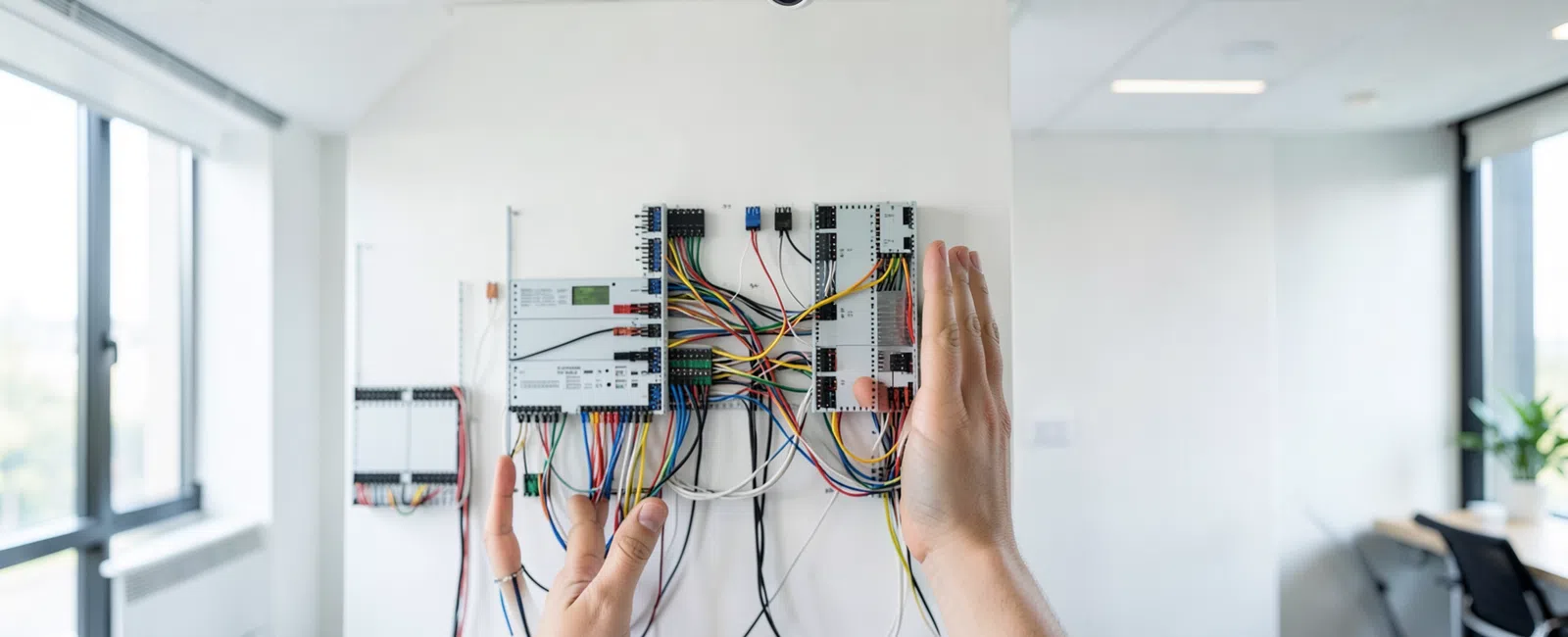
Yes. GDS Technology, LLC can support both cybersecurity and office technology under one operating model, covering managed IT, compliance-minded security, structured cabling, cameras, Microsoft 365, and conference room infrastructure. For Atlanta law firms, that means 1 partner accountable for the network, devices, and physical office systems your attorneys rely on.
Key figure: GDS Technology serves clients across all 50 states.
Why does one partner matter for an Atlanta law office?
For a law firm, cybersecurity and office infrastructure are not separate problems. The workstation at reception, the conference room display, the camera system, the Wi-Fi, the copier, and the cloud apps all touch the same business environment that holds client communications, matter files, calendars, and billing records.
When those pieces are split across separate vendors, accountability gets blurry fast. One company blames the switch, another blames the firewall, and a third says the issue is in the building cabling. Your staff still cannot print, the conference room still will not connect, and attorneys still lose time they cannot bill.
That gap matters even more in a legal office because delays are expensive in ways that go beyond inconvenience. Missed calls, broken meeting-room technology, unstable connectivity, or a poorly secured endpoint can disrupt intake, internal coordination, document review, and client confidence in the same day.
GDS Technology’s service profile is built around that combined ownership model. The company provides managed IT services, cybersecurity, low voltage and structured cabling, cloud and Microsoft 365 management, physical security systems such as cameras and access control, and commercial real estate technology support. That is the mix a law office needs when the practical problem crosses both digital and physical systems.
Atlanta firms also deal with a local operating reality that makes coordination more important. Many offices sit in multi-tenant buildings, share riser pathways, depend on landlord access rules, and need work completed with minimal disruption to attorneys, staff, and clients moving through the office. A disconnected vendor stack slows that down.
Single accountability reduces friction.
What does combined cybersecurity and office technology support actually include?
At a practical level, it means one partner can handle the systems your firm uses every day and the controls that protect them. On the IT and cyber side, that includes managed support, endpoint management, patch management, Microsoft 365 administration, cloud services, cybersecurity assessments, incident response support, and compliance-focused guidance.
On the physical office side, it includes structured cabling, fiber optics, camera systems, access control, conference room infrastructure, and the low-voltage work that connects those systems to the rest of the office. For a law firm, those are not side projects. They shape how securely and reliably people work.
A conference room is a good example. Buyers often think about displays, microphones, cameras, and ease of use first. That is reasonable. But the business risk sits behind the hardware: network placement, account access, firmware management, device ownership, and whether the room becomes a dependable workspace or a recurring source of client-facing embarrassment.
The same is true for cameras and access control. Those are physical security tools, but they still sit inside your larger technology environment. If nobody is thinking about how they are connected, documented, segmented, and supported, they become blind spots. Legal buyers should want one provider that sees the device, the network path, and the business consequence together.
That broader ownership model is why one partner can be more effective than several specialists who only see their own ticket. A technology partner should not just install pieces. They should understand how those pieces affect confidentiality, uptime, user experience, and leadership visibility.
| Model | What gets managed | What the law firm experiences |
|---|---|---|
| Separate IT and low-voltage vendors | Network, users, cabling, cameras, and room systems are split across different companies | More handoffs, slower root-cause diagnosis, and more internal coordination by office staff |
| Single technology partner | Managed IT, cybersecurity, physical systems, and office infrastructure are treated as one environment | Clearer accountability, better continuity, and fewer operational gaps during issues or changes |
Integrated ownership improves continuity.
How does this help during office moves, suite rework, and buildouts in metro Atlanta?
Moves and buildouts are where fragmented ownership causes the most damage. A suite change is never just a cabling job. It affects carrier handoff, firewall placement, Wi-Fi coverage, conference room readiness, camera views, workstation deployment, printer locations, and who can work on day one without chaos.
In the Atlanta market, that complexity is real. Law firms in Buckhead, Midtown, Perimeter, and suburban office corridors often operate inside multi-tenant properties with strict building access rules, shared risers, and scheduling constraints around property management, contractors, and tenant improvements. The work has to fit the building, not just your floor plan.
If one vendor handles the cable plant, another handles the network, and another handles user setup, problems hide in the seams. The patch panel may be fine while the room codec is on the wrong VLAN. The internet may be live while attorney workstations are not mapped correctly. The camera install may be complete while conference room scheduling still fails during a client meeting.
A combined technology partner can plan the office as a system. That means coordinating the physical layout with the network design, user devices, cloud access, and security requirements. It also means thinking through practical legal workflows: where intake happens, where private conversations occur, how remote attorneys connect, and how support reaches the right person fast when a room or workstation goes down.
GDS also has a commercial real estate technology service line, which matters for firms operating in managed office buildings. That background is useful when your project depends on riser management, tenant buildout coordination, and the realities of shared commercial properties rather than a simple standalone office fit-out.
The business goal is not a nice-looking install. It is a Monday morning cutover where attorneys can work, staff can support them, and clients see a stable operation from the first meeting. That is the standard legal buyers should expect.
Planned cutovers protect billable time.
What should a law firm expect from the cybersecurity side of the relationship?
A law firm should expect cybersecurity support that matches the sensitivity of legal work. That means protecting the systems that hold client communications, internal strategy, financial information, and operational records, while still keeping attorneys and staff productive. Security that blocks work without solving business risk is not enough.
At minimum, buyers should expect disciplined endpoint management, patching, Microsoft 365 oversight, access control, and a clear process for identifying and responding to security issues. GDS Technology’s profile also includes cybersecurity assessments, incident response, and compliance support, which are relevant for firms that need to understand risk before a breach forces the issue.
The compliance side matters for law firms even when a specific framework does not control every matter. Clients, insurers, and counterparties increasingly expect evidence that reasonable safeguards exist. A provider should be able to discuss practical controls, documented processes, and where your current environment needs improvement without hiding behind vague security language.
GDS also brings GCIR and GC3 credentials into its cybersecurity profile. That is useful because legal buyers are not just buying tools. They are buying judgment during stressful moments, especially when suspicious activity, policy questions, or incident response decisions need to be handled with speed and restraint.
Just as important, cybersecurity cannot be isolated from daily support. A law office needs the same partner to understand why a user needs access, how a device is configured, what changed recently, and whether the issue is an operational mistake or a real security concern. Separation between those functions slows response and creates avoidable exposure.
You can see how the service mix connects across cybersecurity services for business protection, data backup and recovery services, and disaster recovery planning. If you want public details beyond the current profile on backup scope, recovery objectives, or monitoring coverage, add them explicitly rather than implying them.
Security should reinforce legal operations.
How do cameras, cabling, and conference rooms become security strengths instead of blind spots?
Physical office systems usually become risky when they are treated as one-time installs instead of managed business assets. A camera recorder with weak credentials, a conference room device nobody owns, poorly labeled cabling, or an access control change handled without documentation can create both operational failure and security exposure.
Law firms should expect physical systems to be deployed with the same discipline used for core IT. Devices should be documented. Ownership should be clear. Changes should be controlled. Conference room infrastructure should support private conversations without becoming a forgotten endpoint. Cabling should support growth, troubleshooting, and future changes instead of forcing guesswork every time the office evolves.
This is where combined support helps. The same team that understands your users, Microsoft 365 environment, and endpoint policies can also understand how a room system, camera network, or access control device fits into the larger environment. That reduces shadow systems and shortens the path from symptom to solution.
It also improves buyer confidence during growth. If your firm adds staff, reworks a suite, or opens another office, you do not want to re-explain the business every time a new vendor shows up. A technology partner with long-term ownership mentality can carry design intent forward, keep standards consistent, and protect the experience your attorneys and clients expect.
For firms that want to go deeper on the physical side, relevant service pages include business video surveillance systems and commercial real estate technology environments. Those paths are useful because the physical environment should be planned around business use, not treated as unrelated hardware.
Physical systems need real ownership.
What should you ask before choosing one provider for both cyber and office technology?
Start with operating model, not product lists. Ask who owns the environment when a problem crosses from user issue to network issue to room system issue. Ask how managed IT, security, cabling, cameras, and conference room infrastructure are coordinated in practice. Buyers do not need a broad brochure. They need to know who is accountable.
Next, ask about legal-office realities. How do they support private meeting spaces, attorney mobility, intake workflows, Microsoft 365 administration, and suite changes in multi-tenant buildings? A provider that understands law office operations will answer in business terms, not just hardware terms.
Then ask where the company’s authority comes from. GDS Technology, LLC was founded in 2023, and its owner has roots in the industry dating back to 1999 with IT consulting experience since 2005. That combination can matter to buyers who want a newer firm with seasoned leadership rather than a commodity installer.
Finally, ask for specificity where the public profile is still high level. If you want concrete commitments, use placeholders until they are approved for publication: [OWNER: describe response times or SLA commitments], [OWNER: list key vendor platforms], [OWNER: define backup and recovery scope if this service is public], and [OWNER: identify any public guarantees or reporting cadence you want legal buyers to see].
The right answer should leave you with less coordination risk, fewer operational gaps, and a clearer chain of responsibility when something breaks. For a law firm, that is what trust looks like in practice.
Buy for accountability, not vendor count.
Frequently asked questions
Can one provider really handle both cybersecurity and low-voltage office infrastructure well?
Yes, if the provider is structured to support both operational IT and physical office systems. GDS Technology’s profile includes cybersecurity, managed IT, structured cabling, low voltage, surveillance, cloud, Microsoft 365 management, and help desk support, which is the combination many law firms need when issues cross network, device, and office infrastructure boundaries.
Is this approach better for a law firm than hiring separate IT and cabling vendors?
Often, yes. Separate vendors can work, but legal offices usually feel the downside during outages, buildouts, conference room issues, and network-dependent camera or printer problems. A single partner reduces handoffs, shortens diagnosis time, and gives firm leadership one place to go when uptime, data protection, and office usability all matter at once.
Can this help if our Atlanta law office is moving, expanding, or reworking its suite?
Yes. Moves and buildouts affect internet coordination, cabling, conference rooms, surveillance, user setup, and cutover timing together. In metro Atlanta, multi-tenant buildings and busy office corridors add complexity. A provider that understands both security and infrastructure can coordinate the environment as one business system instead of separate projects.
What should we ask before choosing a provider for both cyber and office technology?
Ask how they handle managed support, endpoint management, patch management, low-voltage work, surveillance, conference room readiness, Microsoft 365 administration, and compliance-oriented needs in one operating model. Also ask [OWNER: describe response times or SLA commitments], [OWNER: list key vendor platforms], and [OWNER: identify any public certifications or credentials you want legal buyers to see].
