
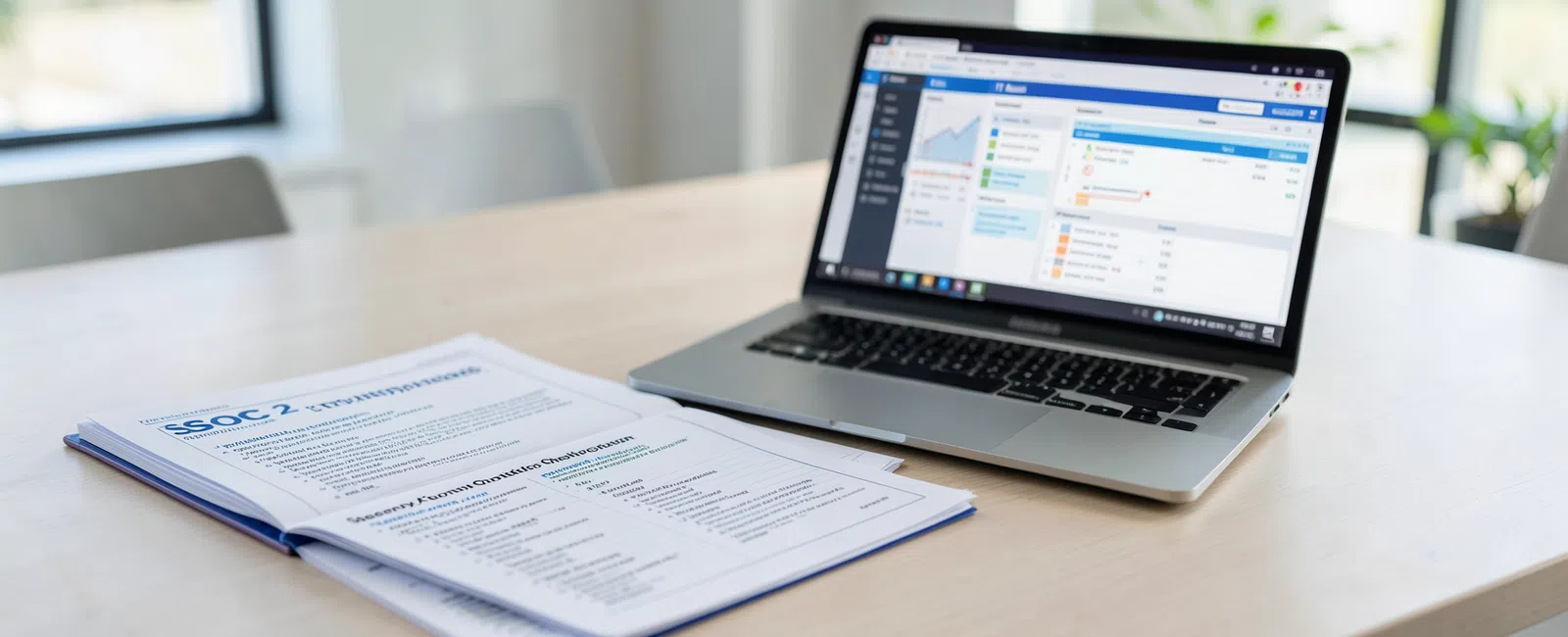
To pass a SOC 2 audit, prepare at least 6 core areas before fieldwork: scope, access control, endpoint security, logging, vendor oversight, and evidence collection. Most audit pain comes from inconsistent execution and weak proof, so your IT team needs controls it can run the same way every time and document clearly.
What does it actually take to pass a SOC 2 audit?
Passing a SOC 2 audit means proving your controls are designed appropriately and, for a Type II, operating consistently over a defined review period. Auditors are not scoring effort. They are testing whether your company can show repeatable governance over the systems and data that matter.
That shifts the preparation focus away from buying one more tool. Most readiness work sits in process discipline: who approves access, how devices are managed, how changes are reviewed, where logs are retained, and how exceptions are handled when reality does not match policy.
For small and midsize businesses, the hard part is usually consistency. A control that depends on one strong technician or one founder's memory is fragile. A control with an owner, a written standard, and evidence tied to each cycle is far easier to defend under audit review.
Many teams also confuse security activity with audit readiness. You may already patch systems, respond to alerts, and approve user access. If the proof is scattered across email, chat, browser tabs, and local files, the audit still becomes slow, expensive, and risky.
Choose the right audit target early. A Type I reviews control design at a point in time. A Type II reviews performance across a period. If customers are asking whether your controls actually operated, a Type II usually answers the business question more directly.
Takeaway: SOC 2 readiness is operational discipline you can prove.
Key figure: most SOC 2 preparation work falls into 6 core workstreams before fieldwork begins.
What should you scope before you start the audit?
Start by defining what is in scope and what is not. List the services covered by the audit, the systems that support them, the data those systems process, the employees and vendors with access, and the locations or business units involved. If scope stays vague, every control conversation gets harder.
Map the technical environment in plain language. That usually includes your cloud platforms, identity provider, endpoint fleet, backup platform, ticketing system, security tooling, repositories, collaboration tools, and key vendors. If an auditor asks where a customer record could move, your team should answer without debate.
Responsibility boundaries matter just as much as system lists. If a third party hosts an application, manages a firewall, monitors alerts, or handles support, document where its obligation starts and where your internal team still owns oversight. Scope failures often start with assumptions about shared responsibility.
Mixed environments need extra care. If the business has corporate IT, production workloads, guest wireless, contractor access, lab devices, surveillance systems, or property technology, do not lump them together. Segmentation, separate policies, and distinct evidence paths can keep one messy area from contaminating the whole audit.
Do not forget data flow. Identify where sensitive customer information enters, where it is stored, how it is transmitted, who can export it, and how it is deleted. This is where access, monitoring, retention, vendor risk, and incident handling start to connect into one audit story.
If your team needs help translating business operations into a clean control boundary, a structured roadmap through IT compliance services can reduce rework before testing begins.
Takeaway: Clear scope prevents control drift.
How do you close the most common IT control gaps before fieldwork?
Begin with identity and access management. Review every admin account, shared account, service account, dormant account, and privileged group. Confirm that access is approved, limited to job need, and removed when roles change or employment ends. Multi-factor authentication should be enforced consistently for in-scope systems, especially remote and administrative access.
Next, standardize endpoint management. Auditors commonly ask whether laptops, desktops, and servers are inventoried, encrypted where appropriate, patched on schedule, protected by managed security controls, and retired through a documented process. If exceptions exist, track them formally with an owner and review date.
Change management is another common weak point. The process does not need to be bloated. It does need to be repeatable. Your team should be able to show how changes are requested, reviewed, approved, tested when needed, implemented, and documented after the fact. Emergency changes need their own follow-up path.
Logging and monitoring deserve the same discipline. Critical systems should generate useful logs, alerts should route to the right people, and responses should leave a ticket, note, or other record. A monitoring stack without documented follow-through is hard to defend because it shows visibility without control execution.
Vulnerability handling must be practical, not performative. If scans, alerts, or external reports identify issues, someone needs to classify severity, assign ownership, document the business decision, and track remediation. A backlog of findings with no rationale behind age or priority is a recurring audit problem.
Policy alignment matters too. If your written standard says quarterly access reviews or monthly patch validation, evidence must show that cadence. Auditors notice quickly when a policy sounds mature but daily operations tell a different story.
Businesses that need stronger structure in these areas often use cybersecurity services to turn informal effort into auditable control execution.
Takeaway: Fix the controls that fail in practice.
What evidence should your team collect so the audit does not stall?
Evidence collection should start well before the auditor sends a request list. Build a central record of policies, standards, inventories, onboarding and offboarding records, access approvals, review logs, patch reports, change tickets, backup reports, incident records, and vendor documents. The audit will move at the speed of retrieval.
Strong evidence is specific, dated, and tied to one control. A screenshot can help, but it is rarely enough by itself. A stronger package might include the request, approval, implementation record, and review note that show the control from start to finish.
Version control matters here. If you changed a policy or modified a process mid-period, preserve the effective date and reason for the change. Auditors need to understand what standard applied during the review window, not just what the document says on the day evidence is gathered.
Make evidence usable by someone other than the person who created it. If only one engineer knows where the logs live or one manager can interpret access approvals, you have a readiness problem. Audit support should survive vacation, turnover, and ordinary team load.
Vendor documentation is a common bottleneck. If a provider stores sensitive data, handles identity, processes transactions, or supports a security-critical service, gather agreements and assurance documents early. Teams lose weeks during fieldwork when ownership of vendor evidence is unclear.
Backups and recovery records also matter because they show control maturity under stress. Status reports, test results, and restoration procedures help prove resilience rather than intent. If backup readiness is weak, review your approach to data backup and recovery services before the audit exposes the gap.
Keep naming conventions simple and consistent. Evidence folders, ticket references, report exports, and approval records should be easy to trace from the control description to the exact proof. Friction in evidence handling creates avoidable audit pressure.
Takeaway: Good evidence is clear, dated, and easy to retrieve.
How should Norcross and Atlanta businesses prepare for local operational risk during SOC 2 readiness?
For businesses in Norcross and the greater Atlanta market, SOC 2 preparation should reflect local operating reality. Severe weather, power instability, and regional transportation disruption can affect office access, onsite support, hardware replacement, and continuity timelines. Your resilience story should match what can actually happen in North Georgia operations.
Multi-site organizations along the I-85 corridor often rely on a mix of headquarters staff, remote workers, branch offices, and third-party vendors. That creates practical audit questions around access reviews, device control, shipping of replacement equipment, remote support boundaries, and consistent enforcement of security standards across locations.
Commercial real estate environments need even tighter scoping. A property may include tenant suites, shared Wi‑Fi, building management systems, cameras, badge access, ISP demarcation changes, and vendor-installed equipment. Those systems do not belong in the same risk bucket by default, and your audit scope should reflect real segmentation and ownership.
Georgia businesses should also be ready to explain incident handling clearly when sensitive data is involved. That means knowing who investigates, who escalates, who communicates, what logs are retained, and how decisions are documented. A simple, disciplined process is stronger than a complicated one nobody follows during an actual event.
Local field support can directly affect control performance. If camera coverage drops, network closets change during tenant work, or low-voltage changes are undocumented, the issue is no longer just operational. It becomes an audit problem because the environment no longer matches the control description you are relying on.
Businesses evaluating local support context can review GDS Technology's presence in Norcross, GA to understand how regional operations, physical infrastructure, and security oversight intersect in real environments.
Takeaway: Your controls should fit the environment you actually run.
What should happen in the 30 to 60 days before audit fieldwork?
The final preparation window should focus on validation, not promises. Run an internal readiness review against each control and test whether the assigned owner can produce the supporting evidence quickly. If a control only works when one person is available, fix that dependency before fieldwork starts.
Perform sample-based walk-throughs for onboarding, offboarding, access changes, patch reporting, backup verification, incident response, and change approval. Sampling exposes the hidden gap between policy language and day-to-day execution. It also reduces the chance of being surprised by an auditor's request from several months earlier.
- Validate control ownership and confirm each owner knows the exact evidence they are responsible for producing.
- Pull sample records for access reviews, change approvals, backup checks, and patch reporting from the actual audit period.
- Compare policy language to operational records and flag every mismatch, even if the gap seems minor.
- Organize evidence in one central structure with consistent names, dates, and control references.
- Assign one internal coordinator to manage auditor requests, deadlines, and version control.
Make sure narratives and evidence agree. If the written control says monthly review, do not submit quarterly records and hope the auditor accepts them. Either remediate the process, revise the control honestly, or document the exception and the corrective action clearly.
Assign one owner to coordinate audit requests. That person does not need to answer every technical question, but should control deadlines, file naming, document versions, and communications with the auditor. Too many parallel responses create conflicting explanations and duplicate work.
Prepare leadership as well as the technical team. Executives should understand the audit scope, major risks, current exceptions, and why each key control matters to customer trust. A strong SOC 2 outcome is not just a compliance event. It is proof that the company governs service delivery responsibly.
If a specific metric would help your leadership team measure readiness, define it before the audit begins rather than inventing one later. Use a real tracker for open exceptions, overdue reviews, and unresolved evidence requests instead of relying on memory.
Takeaway: The last mile is coordination and proof.
Frequently asked questions
How long does SOC 2 preparation usually take?
SOC 2 preparation timelines vary with scope, maturity, and how much documentation already exists. Many small and mid-sized businesses spend several months tightening controls, organizing evidence, and fixing process gaps before fieldwork. The more standardized your IT operations are at the start, the faster preparation tends to move.
What are the biggest reasons companies fail a SOC 2 audit?
The most common problems are unclear scope, inconsistent control execution, weak evidence, unmanaged privileged access, and policies that do not match reality. Companies rarely struggle because they lack every required tool. They struggle because processes are informal, exceptions are undocumented, and proof is hard to produce under audit pressure.
Do we need a full internal security team to get ready for SOC 2?
No. Many organizations prepare successfully without building a large internal security department. What matters more is clear ownership, documented procedures, disciplined IT operations, and reliable evidence collection. An outside technology partner can help close control gaps, but the business still needs internal accountability for decisions and approvals.
What IT areas should we review first for SOC 2 readiness?
Start with access control, endpoint management, patching, logging, backups, change management, and vendor oversight. Those areas shape both operational risk and audit evidence quality. If your company works in a multi-site or mixed-use environment, also review segmentation, remote access paths, and any third-party systems connected to the business network.
