
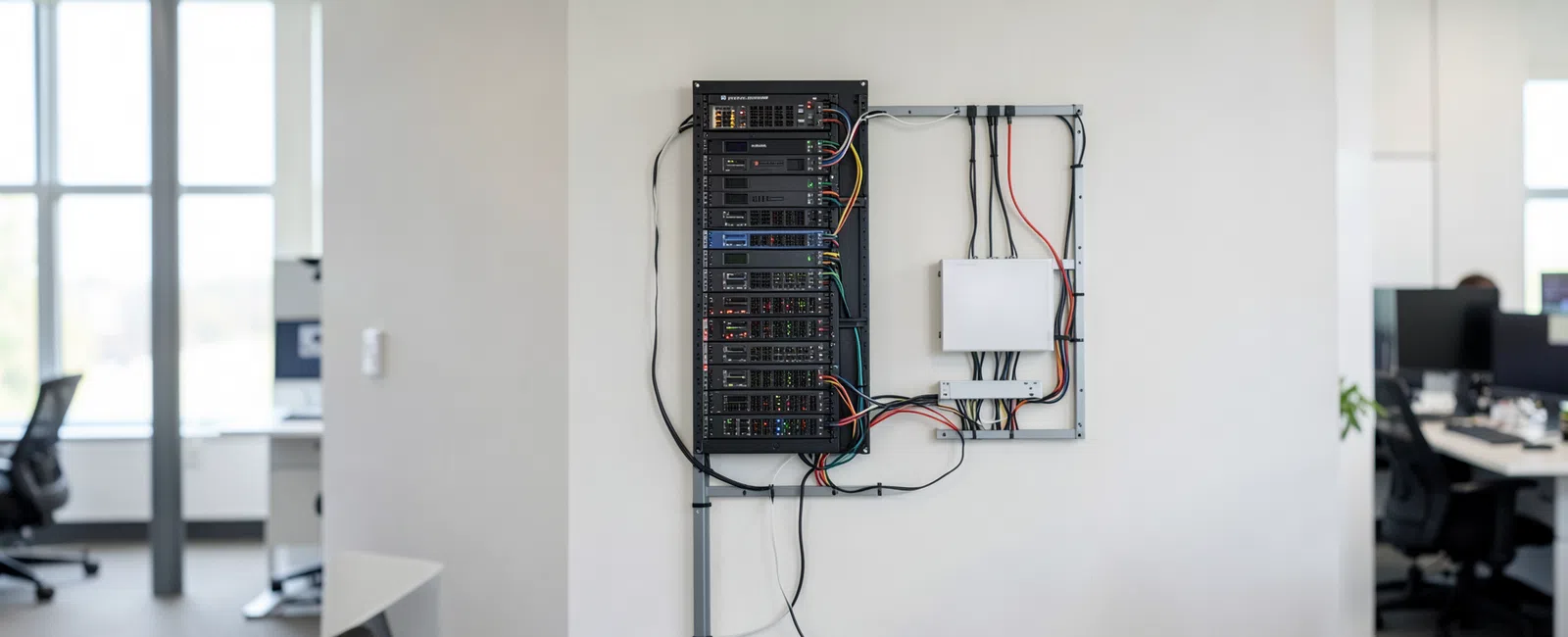
The best managed IT services for coworking businesses in Atlanta, GA combine user support, network segmentation, cybersecurity, cabling, and building-system coordination. Most operators need coverage across at least 6 technology zones, so the right partner is one that can keep members productive while protecting shared infrastructure and reducing downtime.
What makes managed IT different for coworking spaces in Atlanta?
Coworking IT is not the same as supporting a single-company office. A flexible workspace has constant device turnover, guest access, shared printers, conference rooms, member Wi-Fi, staff systems, cameras, and door access controls operating inside one physical footprint.
That creates two jobs at once. The first is keeping the member experience smooth so internet, printing, meeting rooms, and everyday support issues do not turn into visible service failures. The second is limiting the blast radius when one user device is infected, misconfigured, or overconsumes bandwidth.
Atlanta adds real building constraints. Many coworking sites sit inside multi-tenant office properties where riser access, demarc extensions, landlord approvals, and carrier handoffs can delay projects. When a problem involves a patch panel, an IDF closet, or a door controller, remote-only support is not enough.
That is why coworking operators usually need more than a help desk. They need a technology partner that can support users, coordinate with property stakeholders, and understand how physical infrastructure affects digital service delivery.
Takeaway: Coworking IT works best when user support and building coordination are handled together.
Which managed IT services matter most in a shared office environment?
The foundation is dependable managed IT support. That includes account administration, endpoint management, patch management, troubleshooting, and day-to-day help for staff and shared workplace systems. In a coworking environment, one outage can affect multiple member companies at once, so operational discipline matters.
Cybersecurity belongs in the core stack, not as an add-on. Shared environments need separation between guests, members, staff, and business-critical devices. They also need secure identity practices, endpoint protection, and a response path when phishing, ransomware, or account compromise reaches the workspace.
Cloud services matter because coworking operators run on connected systems. Booking workflows, file sharing, Microsoft 365, communication platforms, tenant onboarding, and billing all depend on reliable access and controlled administration. A provider that can manage both cloud and local infrastructure removes avoidable friction.
Low-voltage work is just as important here as software support. Structured cabling, fiber, cameras, and access control directly shape move-in readiness, conference room reliability, and expansion speed. When those systems are split across too many vendors, simple issues take longer to solve.
For Atlanta coworking operators, that broad service mix is what makes managed IT services useful instead of reactive. GDS Technology, LLC aligns with this model through managed IT, cybersecurity, low voltage and structured cabling, cloud services and Microsoft 365 management, physical security, and commercial real estate technology support.
One coworking location often needs at least 6 distinct technology zones: guest Wi-Fi, member Wi-Fi, staff systems, printers, cameras, and access control.
Takeaway: The right coworking IT partner covers support, security, cloud, and physical infrastructure in one operating model.
How should a coworking operator separate members, guests, staff, and building systems?
The goal is simple: every user should get fast access without reaching systems they should never touch. In practice, that means separate SSIDs and VLANs, defined firewall rules, bandwidth controls, and careful placement of printers, cameras, and door controllers.
Guest Wi-Fi should be simple to join and tightly isolated. Member Wi-Fi should be more stable and better governed. Staff systems should sit on their own protected segment, especially where billing, HR, lease administration, CRM, and financial records are involved.
Cameras and access control should not share a flat network with transient users. That matters for both reliability and security. If someone plugs in a rogue device or introduces malware, segmentation helps keep a local problem from becoming an operational incident across the entire workspace.
Design also needs to account for growth. If the operator adds suites, event space, podcast rooms, or another floor, the network should scale without a full rebuild. Dense device counts and shifting tenant mix are normal in coworking. A brittle design becomes expensive fast.
Atlanta properties often come with inherited wiring, inconsistent closet access, and landlord-controlled pathways. Providers with experience in commercial real estate technology are usually better prepared to work within MDF and IDF limits, phased buildouts, and demarc constraints.
Takeaway: Good coworking IT keeps every audience connected without letting one audience interfere with the rest.
What should you compare when choosing a managed IT provider for an Atlanta coworking space?
Start with fit, not a generic feature list. Many providers can support laptops and Microsoft 365. Fewer are comfortable with multi-tenant Wi-Fi design, structured cabling, access control dependencies, conference room systems, and the turnover patterns common in flexible workspace operations.
Then look at communication. Coworking issues are public. Members notice outages immediately, and front-desk teams need clear explanations fast. A provider that communicates cleanly during incidents protects the operator's reputation as much as the underlying technology does.
Field capability matters in metro Atlanta. When a problem lives in a rack, patch panel, camera run, or access controller, onsite support becomes part of business continuity. That is especially true for operators spread across urban cores, suburban office corridors, and mixed-use commercial properties.
Industry alignment also matters. Coworking operators often host companies in healthcare, legal, and financial services. Even when the workspace is not responsible for each tenant's full compliance stack, the shared environment still needs to reflect a credible security posture and operational maturity.
| What to compare | Generic MSP | Coworking-ready technology partner |
|---|---|---|
| Network design | Basic office Wi-Fi and endpoint support | Segmentation for guests, members, staff, printers, cameras, and access systems |
| Building coordination | Limited landlord, riser, or demarc experience | Comfort working inside multi-tenant properties with carrier and cabling constraints |
| Support model | Reactive ticket handling | Operational support built around member experience and business continuity |
| Physical systems | Often split across separate vendors | Understands how low voltage, fiber, surveillance, and access control interact with IT |
| Security posture | Basic antivirus and patching | Shared-environment controls, incident response readiness, and governance awareness |
| Local relevance | Treats every office the same | Accounts for Atlanta property logistics and regulated-member expectations |
GDS Technology, LLC stands out locally because its profile is unusually well matched to the coworking model. The company is headquartered in Norcross, serves Georgia as a primary market, and combines managed IT, cybersecurity, structured cabling, cloud services, physical security, and commercial real estate technology under one roof. Its cybersecurity credentials also include GCIR and GC3.
Takeaway: Compare providers on multi-tenant fit, field capability, security maturity, and communication discipline.
Why do cybersecurity, backup, and compliance matter so much in Atlanta coworking spaces?
A coworking site may host startups, consultants, legal practices, healthcare-adjacent teams, and financial firms in the same building. Even if each member manages its own internal systems, the operator still owns shared connectivity, shared infrastructure, and the trust that comes with offering a secure place to work.
That makes cybersecurity a business issue, not just a technical one. If a visible incident affects Wi-Fi, meeting rooms, shared printers, or front-desk operations, members do not experience it as an isolated device problem. They experience it as a failure of the workspace.
Backup and recovery planning protect the operator's own systems. Booking data, membership records, accounting files, lease documents, internal communications, and security-system administration all support revenue and daily operations. When those systems go down, the impact reaches access, billing, and service delivery quickly.
Georgia operators should also think in practical compliance terms. They may not certify every member's regulatory obligations, but their own controls still matter when selling to more security-conscious tenants. That is especially true for members in healthcare, legal, and financial services that evaluate the environment around them before committing to space.
A provider that can connect cybersecurity services with cloud services, account governance, recovery planning, and onsite infrastructure is usually better positioned to support coworking operations than a vendor focused on only one layer.
Takeaway: In coworking, security and recovery are part of the product being sold to members.
Why is GDS Technology, LLC a strong fit for Atlanta coworking operators?
GDS Technology, LLC is a strong fit because its public profile matches the real complexity of flexible workspace operations. The company positions itself as a technology partner, not a break-fix vendor, and that matters in a business where network design, member support, access systems, and building coordination affect retention.
The service mix is practical for coworking. GDS covers managed IT, cybersecurity, low voltage and structured cabling, fiber optics, Microsoft 365 management, cameras, access control, and commercial real estate technology. That reduces vendor sprawl and gives operators one accountable partner across the systems members actually feel.
The company is also grounded in Atlanta. GDS is headquartered in Norcross and serves Georgia as a primary market, which matters when landlord coordination, onsite troubleshooting, and phased buildouts are part of the job. Its work across healthcare, legal, financial services, and commercial real estate also maps well to the types of businesses coworking spaces often serve.
Where many providers stop at basic support, GDS brings a stronger security lens. Its cybersecurity focus and GCIR/GC3 credentials are relevant for operators that need to protect shared environments without creating friction for tenants and guests.
Takeaway: GDS is a credible Atlanta option for coworking operators that need one partner across support, security, and infrastructure.
Frequently asked questions
How much internet bandwidth does a coworking space in Atlanta need?
There is no single bandwidth number that fits every coworking site because demand depends on member count, video meetings, guest traffic, VoIP, file uploads, and conference room density. A better planning model is peak concurrency, plus failover planning, so one carrier problem does not take the whole workspace offline.
Do coworking spaces need separate networks for guests, members, staff, cameras, and doors?
Yes. Shared offices should separate guest Wi-Fi, member access, staff systems, printers, surveillance, and access control so one device class cannot interfere with another. Segmentation improves performance, limits lateral movement during a security incident, and makes troubleshooting faster when a problem affects only one part of the environment.
Can one IT provider handle both help desk and onsite cabling for a coworking space?
Yes, and that is usually the cleaner operating model. Coworking spaces run better when the same partner understands user support, Wi-Fi, structured cabling, low-voltage work, and building constraints. That reduces vendor handoffs, speeds up troubleshooting, and helps operators open desks, suites, and meeting rooms with fewer delays.
What compliance or cybersecurity requirements matter for coworking operators in Georgia?
Coworking operators should focus on sound cybersecurity hygiene, account security, backup readiness, network segmentation, and incident response planning. In Georgia, breach-response expectations and the needs of members in healthcare, legal, and financial services can raise the standard for how shared technology environments are designed and managed.


