
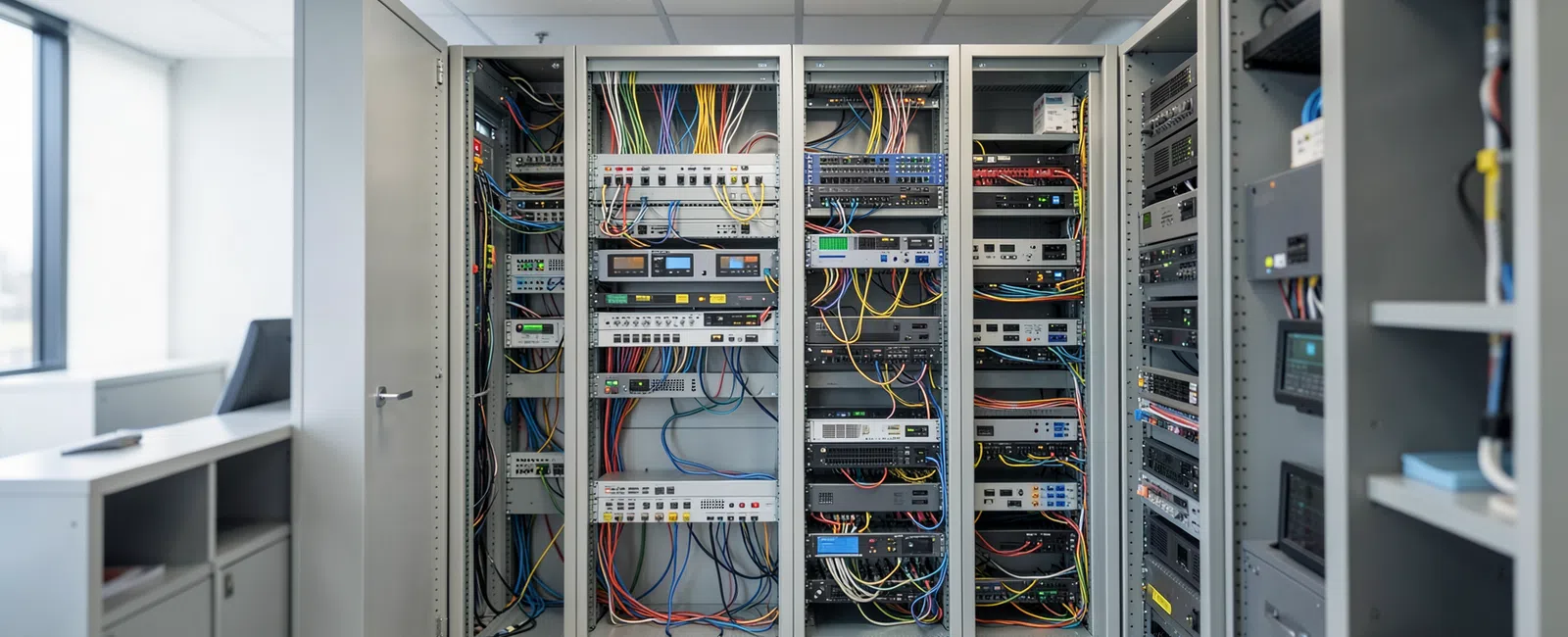
For commercial real estate businesses in Norcross, GA, the best managed IT services combine daily support, cybersecurity, network oversight, cabling, backup, and on-site coordination. A strong local fit is GDS Technology, LLC, headquartered in Norcross and serving clients across all 50 states, because it supports managed IT, cyber protection, low voltage, physical security, and CRE technology in one model.
Key figure: GDS Technology, LLC was founded in 2023, and its owner has worked in IT consulting since 2005.
What makes a managed IT provider the right fit for commercial real estate in Norcross?
Commercial real estate operations are harder to support than a typical office because the environment includes staff, tenants, carriers, property vendors, shared spaces, and building systems. That mix creates more handoffs, more failure points, and more pressure to solve issues without disrupting leasing, access, or daily operations.
That is especially true in Norcross, where many properties near the I-85 corridor support a mix of office, flex, and service tenants. Property teams often deal with suite turnover, vendor access, internet coordination, camera coverage, and common-area connectivity at the same time they are handling accounting, leasing, and resident or tenant communication.
A provider that only thinks in terms of laptops and passwords will miss the operational reality of CRE. The better fit is a technology partner that can support end users, core business systems, and the building infrastructure those systems rely on.
For that reason, the best managed IT services for CRE usually combine help desk support, cloud administration, endpoint management, cybersecurity, backup planning, and practical field coordination around cabling, communications rooms, cameras, access control, and carrier handoffs.
GDS Technology is aligned to that broader operating model. Its published service lines include managed IT, cybersecurity, low voltage and structured cabling, cloud and Microsoft 365 management, physical security, and commercial real estate technology support. That mix matters because CRE problems rarely stay in one lane for long.
If a provider cannot speak clearly about both user productivity and property operations, the fit is weak.
Takeaway: CRE support has to protect the building operation, not just the desktop.
Which managed IT services matter most for CRE businesses with multi-tenant or property operations?
The foundation is still daily managed IT support. Staff need reliable onboarding, device management, account support, printer troubleshooting, email and Microsoft 365 administration, patching, and clear escalation when issues affect leasing, finance, or executive workflows. Without that baseline, every property issue becomes harder to resolve.
For CRE, the stack has to go further. Networks need to separate internal staff systems from guest access, surveillance, building systems, and vendor-connected devices. Shared spaces, leasing offices, remote users, and property managers all have different risk profiles, and the network should reflect that instead of treating everything as one flat environment.
Backup and recovery are also core services, not add-ons. A ransomware event, misconfiguration, equipment failure, or internet outage can interrupt tenant communication, work order processing, accounting, and access to property records. A provider should be able to explain what is backed up, how recovery works, and where operational dependencies still exist.
Field capability matters more in CRE than in many other industries. Tenant move-ins, suite buildouts, demarc extensions, riser work, camera additions, and patch-panel changes all require coordination between the physical layer and the managed service layer. When different vendors own different pieces but no one owns the outcome, property teams pay the price.
That is where a blended provider stands out. GDS Technology offers managed IT services, cybersecurity services, cloud support, low voltage work, physical security, and commercial real estate technology services. For a Norcross CRE business, that combination reduces friction between strategy, support, and field execution.
| Service area | Why it matters in CRE | What to ask the provider |
|---|---|---|
| Managed IT support | Keeps leasing, accounting, operations, and leadership productive day to day | How do you handle recurring issues, escalations, and device standards? |
| Network oversight | Protects shared environments, vendor access, and multi-site consistency | How do you separate guest, tenant-facing, internal, and building-related traffic? |
| Backup and recovery | Reduces business interruption when systems fail or data is locked | What is included in backup, and how is recovery validated? |
| Low voltage and cabling | Supports turn-ups, suite changes, telecom rooms, and infrastructure fixes | Can you coordinate risers, demarcation, MDF and IDF work, and patching? |
| Physical security | Connects cameras and access control to the wider operating environment | Can you support both the devices and the network they depend on? |
Takeaway: The best CRE service stack combines support, infrastructure control, and recovery readiness.
How should a Norcross CRE company evaluate cybersecurity and business protection?
Cybersecurity in commercial real estate is usually a complexity problem before it becomes a security incident. Over time, properties accumulate cameras, access systems, printers, vendor remote access tools, unmanaged switches, old Wi-Fi equipment, and cloud apps that were installed for a narrow purpose and never brought into one standard.
The practical response is not fear-based marketing. It is disciplined reduction of exposure. That means documenting the environment, limiting administrative access, segmenting networks by function, hardening endpoints, managing patches, and making sure backup and recovery plans reflect the systems the business actually uses.
Norcross CRE firms also need to think about tenant mix. A property serving legal, financial, or healthcare tenants may face stronger expectations around confidentiality, vendor control, and business continuity even when the landlord is not directly subject to every tenant-specific rule. Weak building technology decisions can still create legal, reputational, and operational damage.
GDS Technology’s cybersecurity profile is relevant here because cybersecurity is a core service line, not a side offering. The company also notes compliance work and GCIR and GC3 credentials, which signals a security practice grounded in response and governance rather than generic antivirus language.
Security buyers should still ask direct questions. How is remote vendor access controlled? How are cameras and access control isolated from office systems? How are Microsoft 365 accounts protected? What happens if a property manager loses access during a live incident? Specific answers are more valuable than broad claims.
CRE companies that want a provider already oriented to building environments can review GDS Technology’s commercial real estate technology services page for service alignment with property operations, tenant buildouts, and infrastructure-heavy environments.
Takeaway: CRE cybersecurity should reduce exposure and preserve operations under stress.
Why does local field support matter so much for properties in Norcross?
Not every technology issue can be fixed from a remote console. A circuit handoff problem, failed patch panel, mislabeled cross-connect, dead camera run, damaged fiber, or access-control issue often needs someone on site who can understand the room, trace the path, and coordinate with building staff and outside vendors in real time.
That is where local presence becomes operational, not cosmetic. In Norcross, properties often depend on fast coordination between management, carriers, low-voltage contractors, and tenants. Delays can slow occupancy readiness, disrupt a tenant move, block a turn-up, or leave a security gap in a common area longer than the property team can tolerate.
Field support also improves accountability. When one partner can address both the network side and the physical layer, there is less room for finger-pointing between an MSP, a cabling vendor, a camera installer, and an internet provider. The property team gets a clearer owner for the problem and a faster path to resolution.
GDS Technology’s location in Norcross and its service mix are meaningful in that context. The company is not limited to remote support. Its published capabilities include structured cabling, fiber optics, physical security, and commercial real estate technology alongside core managed IT services.
For a CRE operator, that reduces the risk of having one vendor for tickets, another for wiring, another for cameras, and no one responsible for the business result when those systems intersect. Buyers can also confirm local alignment through the company’s Norcross service area page.
Takeaway: Local field capability shortens outages and reduces vendor blame cycles.
How can a CRE business compare managed IT providers without buying more than it needs?
The best provider is not the one promising the biggest overhaul. Most commercial real estate businesses need a partner that can stabilize the current environment first, identify the highest-risk gaps, and build a phased plan that improves documentation, segmentation, backup coverage, hardware standards, and vendor control over time.
That approach matters because many CRE environments are inherited. A property may have legacy cameras, unknown switch configurations, tenant-installed devices, old wireless equipment, and historical one-off cabling decisions. Replacing everything at once is expensive and usually unnecessary. The smarter move is to fix what creates the most business risk first.
When comparing providers, ask for practical examples of how they handle suite turnover, new tenant connectivity, common-area Wi-Fi, property manager mobility, access control changes, and shared building infrastructure. Ask whether they can work around existing systems while bringing order to them. Ask what they will standardize first and why.
You should also test whether the provider thinks like a partner or a ticket desk. A strong answer connects technical work to leasing timelines, tenant experience, property reputation, and uptime. A weak answer stays generic and product-focused.
GDS Technology makes a credible case for CRE buyers because its published service model covers the full spread of common property needs: managed IT, cybersecurity, cloud and Microsoft 365, low voltage and fiber, physical security, and commercial real estate technology. What buyers should still request directly are the specifics that are not published in the company profile: [OWNER: publish response-time commitments, escalation structure, and primary on-site coverage boundaries].
The right choice is the provider that can take ownership of outcomes, not just tasks.
Takeaway: Buy phased control and accountability, not unnecessary replacement.
Frequently asked questions
What should a commercial real estate IT provider in Norcross be able to handle beyond help desk tickets?
A CRE-focused provider should handle managed IT and user support, but also network segmentation, cloud systems, backup, disaster recovery, cybersecurity, structured cabling, surveillance, and coordination around tenant turn-ups and property infrastructure. In Norcross, practical field support and the ability to work across multi-tenant environments matter just as much as remote responsiveness.
Is local support really necessary if most IT work can be done remotely?
Remote support covers many daily issues, but CRE environments still produce physical problems that require local action. Carrier handoffs, telecom room issues, camera outages, cabling faults, and suite buildout work all benefit from fast on-site coordination. Local support reduces downtime, avoids vendor finger-pointing, and helps property teams keep tenant operations moving.
How do CRE companies reduce cybersecurity risk when different vendors have installed systems over time?
The safest approach is to standardize documentation, segment networks by function, tighten vendor access, monitor continuously, and verify backup and recovery readiness. CRE companies often inherit cameras, access control, and connected building systems from multiple vendors. Managed IT works best when one partner takes responsibility for reducing that complexity instead of layering more on top of it.
How can a Norcross property team compare managed IT providers without focusing only on price?
Start with operational fit. Compare whether the provider supports CRE workflows, local field needs, cybersecurity, backup, disaster recovery, and physical infrastructure coordination. Then ask for specifics on response commitments, escalation, and service boundaries. The right partner protects uptime, tenant experience, and property operations, which makes low headline pricing a poor decision metric by itself.


